
 Lili Arabuli

Abstract and figures:
With antimicrobial resistance (AMR) on the rise, there is an urgent need for non-antibiotic approaches to treatment. Antimicrobial photodynamic therapy (aPDT) is being investigated as a non-antibiotic strategy for treating infections caused by multidrug-resistant (MDR) organisms. In this review we offer a thorough examination of phthalocyanines (Pcs) and metallophthalocyanines (MPcs), second-generation photosensitizers investigated mainly for bacterial and fungal photoinactivation. Antiviral aPDT is discussed separately because Pc-specific antiviral evidence remains comparatively limited. Our analysis focuses on how central-metal electronic configuration, spin–orbit coupling, and peripheral substitution influence intersystem crossing, triplet-state formation, and reactive oxygen species (ROS) generation in metallophthalocyanines. We also consider the physicochemical constraints that come with these compounds, namely their tendency to undergo aggregation-induced quenching (AIQ) in aqueous solution. To counter this and to get past the outer membrane of Gram-negative species, we evaluate synthetic changes such as cationic peripheral functionalization. The paper further explores how Pcs are being combined with pharmaceutical nanotechnology – be it liposomes, metallic nanoparticles or graphene oxide – to improve bioavailability and open the door to synergistic photothermal therapy (PTT). The promise of Pc-conjugates linked to bioactive agents like antibiotics is likewise noted. Yet for all the in vitro and preclinical data accumulated over the years, phthalocyanine-based aPDT has seen little use in the clinic. We close with an appraisal of the reasons for this shortfall, from issues of dosimetry and localized hypoxia to difficulties in penetrating biofilms, and put forward the case for engineering stimulus-responsive nanoplatforms as a way to bridge the regulatory and biological divide.
SUBJECT:
Phthalocyanines, Metallophthalocyanines, Antimicrobial Photodynamic Therapy, Reactive Oxygen Species, Antimicrobial Resistance, Nanodrug Delivery Systems
GRAPHICAL ABSTRACT:
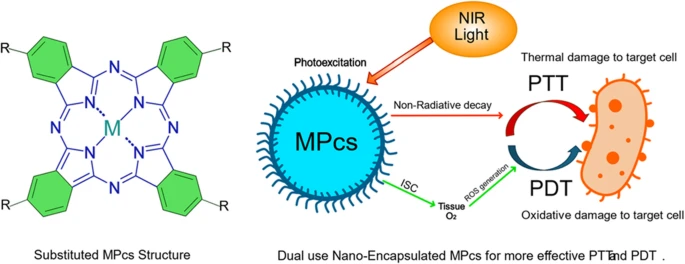
Light-activated, nano-encapsulated metallophthalocyanines enable photodynamic and photothermal pathways, illustrating their potential as multifunctional antimicrobial platforms.
Selected Figure
Fig. 2. Structural and photophysical design features of metallophthalocyanines in antimicrobial photodynamic therapy.